

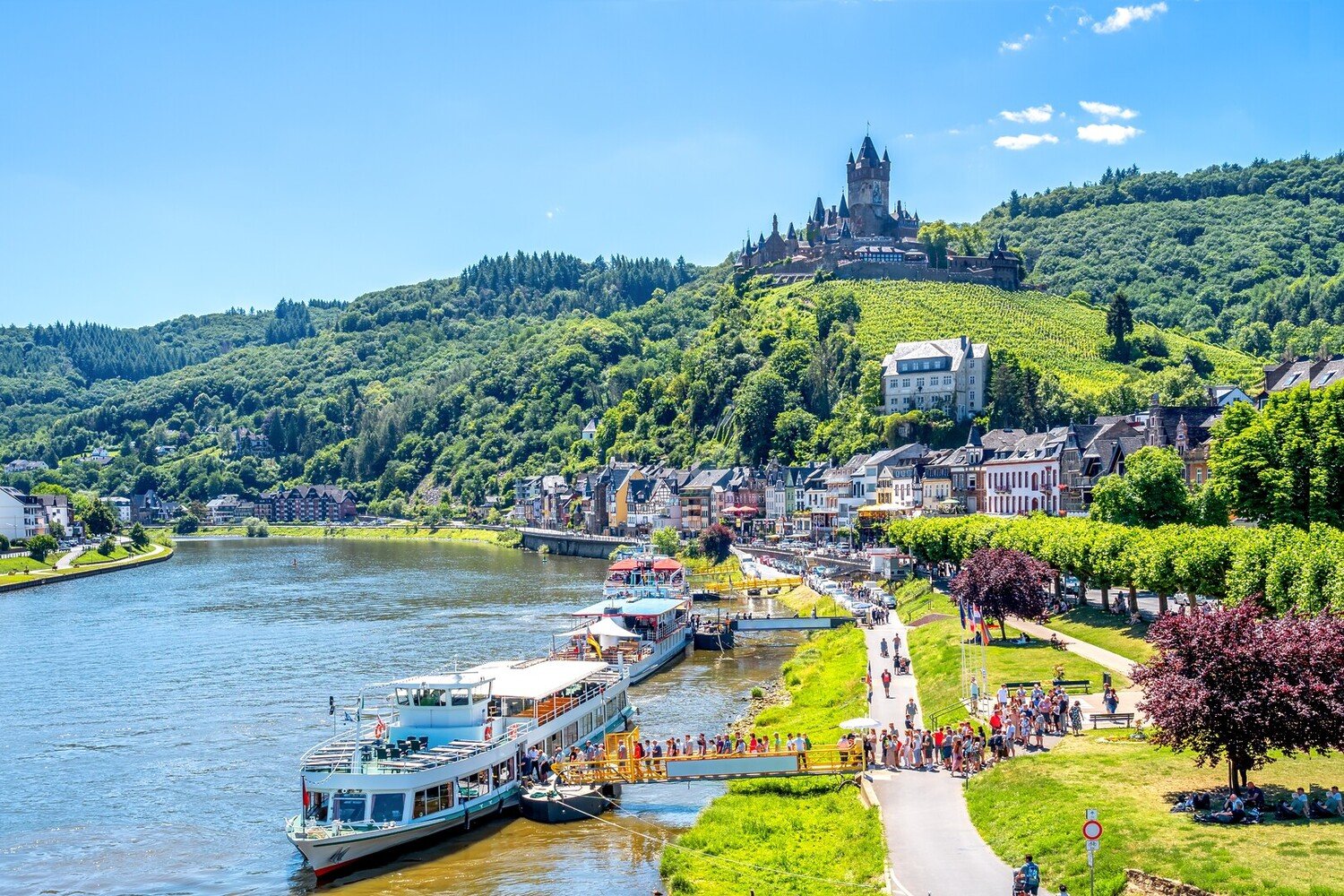

Germany’s Mosel wine region is the place of fairytale villages, medieval castles, and ancient Roman history – just with wine added. In short, it’s a dream for adults and doesn’t disappoint its hundreds of thousands of visitors each year. Before you head off to the region, learn more about it to make your trip better understood and much more enjoyable.
Your Visit Could Help Preserve the Mosel Region’s Interesting Wine-Making History
The Mosel Valley is not Germany’s largest wine region – in fact, it’s the fifth largest – but it’s certainly one of the more interesting ones. Some say that it’s the most important tourist destination in the state of Rheinland-Pfalz.
You’ll see some of Germany’s favourite wines grown on almost impossibly steep slopes. Research shows that local wine-makers are gradually abandoning the slopes, so driving tourism to the area could help the wineries continue the tradition. Without valuable tourism each year, the dramatic scenery (and undoubtedly a major drawcard) could become a thing of the past.
The Romans Turned the Mosel Into a Wine Region
The Mosel’s wine story started with the Romans. And knowing that will likely change how you see and experience the valley. The region’s wine history spans roughly two thousand years. Roman vineyards can be found along the Moselle, Saar, and Ruwer. This region is now considered Germany’s oldest wine-growing region.
Trier is the best place to begin if you want to understand the ancient wine history properly. The city was founded in the Roman era, and its influence can still be clearly seen. You can walk past the Porta Nigra, see the Roman Bridge, and visit bath complexes that show off the sheer scale of Roman life. Back then, the river was important for the same reasons it’s important today – transporting people, goods, and wine through the region.
If you’re intrigued by the Roman background in the region’s wine production, you’ll enjoy a visit to Piesport. The town has its own major wine press site, which is the perfect place to learn more about ancient viticulture. It is one thing to hear that the Romans made wine here, and quite another to stand where they actually processed grapes and recognize that the landscape in front of you has supported that work for centuries on end.
The Mosel’s Castles Are Part of Its History
Once you’ve had your fill of Roman history, you’ll learn that there’s another story the region tells through its castles. These were not built to entertain modern travellers with attractive photographs, though they do that very well. They were strategic buildings in a river valley that had political, economic, and military importance.
Cochem is one of the best places to feel that medieval atmosphere. Reichsburg Cochem rises more than 330ft above the town. The current appearance includes a nineteenth-century restoration, but the site still sits in a medieval setting. When you approach from the old town or see it from the river, it becomes obvious why the Mosel still feels like a combination of a historical monument and a storybook.
Burg Eltz also belongs on any serious Mosel itinerary, even though it sits slightly away from the main wine route. The castle has remained in the same family for centuries and feels both grand and unexpectedly intimate. Visiting it reminds you that the Mosel was never only about wine. It was also about noble families, control of land, and the need to defend routes that brought wealth through the region.
Wine Villages Are Historically and Currently Important
The Mosel’s history is not trapped inside museums and castles. It is visible in the towns themselves, especially in places where the environment still reflects older trade and wine traditions.
Bernkastel-Kues is a perfect village to see older trade and wine traditions. The region is popular for heritage travel because of its half-timbered houses, medieval market square, and hilltop castle ruins.
This is the part of the trip where history becomes pleasantly walkable. You do not need to spend every hour reading plaques or taking formal tours. Sometimes the region explains itself through a market square, a church tower, or a narrow lane that opens onto a river view and a row of vineyards. The Mosel doesn’t present history as a classroom exercise, and that’s part of its appeal. You can learn a lot about the area while at lunch, on a river walk, visiting a cellar, or enjoying a languid dinner.
The Steep Slopes Are Part of the Story
The vineyards are not simply decorative scenery around the Mosel’s history. They are the history. The region is famous for steep slopes, and some of them are astonishingly severe. The Calmont vineyard sits on a 65-degree incline and is often described as one of the steepest vineyards in the world. It’s these slopes that give Mosel wine such a strong identity. The vineyards demand labour, patience, and a willingness to keep old practices alive in difficult terrain.
Tasting Riesling in the Mosel is enjoyable on its own, but the experience becomes far richer when you understand the physical effort behind it. A glass of local wine is also a reminder that this valley still depends on people who are willing to farm land that machines cannot easily tame.
How to Experience the Mosel Today
The best Mosel trips combine being active and taking time to simply relax and enjoy your surroundings. You can cruise part of the river, cycle between towns, or walk sections of the valley that open up broad views over the vineyards. You can also spend some days a bit slower, enjoying wine tastings and local food.
A good short itinerary might begin in Trier for Roman history, continue to Bernkastel-Kues for the old town atmosphere, and include Cochem for castle views and easy access to the river. If you have more time, add Piesport for the Roman wine press and Bremm for a look at the famous steep vineyards.
When you are moving between villages, checking train times, and trying to decide which winery or trail to tackle next, an international eSIM makes the practical side of the trip much easier. It helps with maps, reservations, opening hours, and route changes without forcing you to depend on unreliable public Wi-Fi while you are out for the day.
Enjoy Learning About the Mosel’s Past
The Mosel is memorable because it doesn’t rely on one attraction alone. Roman engineering, medieval ambition, wine culture, and dramatic geography make the area interesting. When you visit with a bit of historical context, the valley becomes more than a beautiful backdrop for a tasting holiday.

Victoria explores Europe's wine regions to share the finest wine tourism experiences with our travelers. Here she shares her favorite discoveries, tips, and encounters with the winemakers behind every bottle.


